Blog
The Science of Purpose
How purpose powers wellbeing
Living with purpose brings more than just meaning to your life. It’s a lever that can impact virtually every aspect of your psychological, physical, emotional, and behavioral wellbeing. More than 1,400 studies have examined purpose in life, and the results are clear. A strong sense of purpose is associated with a host of wellbeing benefits, many of which may be surprising. But first, let's talk about the science behind why purpose works so well as a powerful wellbeing tool.
NOTE: You'll see footnotes throughout this text for related studies—you can find an ordered listing of those studies at the bottom of this page.
The Neuroscience
What happens in the brains of people with a strong sense of purpose?
Some of the world’s leading neuroscientists have studied the effect of purpose on people’s brains through magnetic resonance imaging1,2,3 and have found three primary neural responses:
- People with a strong sense of purpose have reduced cognitive conflict. The dorsal anterior cingulate, and area of the brain associated with conflict, is less active in people with a stronger sense of purpose.
- Purpose activates neural regions associated with emotional self-regulation and control of fear and anxiety. The ventromedial prefrontal cortex, which is associated with our sense of self, decision-making, and future orientation, is activated when purposeful values are affirmed in study subjects.
- Activation of the ventromedial prefrontal cortex suppresses activity in the amygdala, the fear center of our brains.
This is your brain on purpose
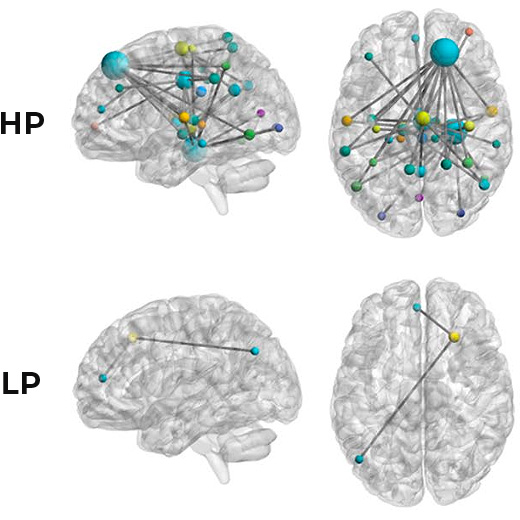
The following image shows resting-state functional magnetic resonance imaging (rs-fMRI) scans of high purpose (HP) and low purpose (LP) research subjects4 — you can see for yourself how much more interregional activity occurs in the HP brain versus the LP brain.
Benefits of strong purpose in life
Our neural responses help explain the many psychological, emotional, physical, behavioral, and even financial benefits we see in people with a strong sense of purpose. Research has found having a strong sense of purpose is linked to a host of benefits, including the following:
- Longer, better lives.5 A strong sense of purpose is associated with adding 7 to 7.5 years to a person’s life.
- Better sleep. Researchers have found that a strong sense of purpose supports both a better night’s sleep when measured in isolation,6 and better sleep over time.7
- Greater resilience to psychological stressors, including negative events8 and trauma.9,10,11
- Lower levels and lower risk of depression and anxiety. People who have a strong sense of purpose are roughly half as likely to be depressed and anxious as those who don’t. Many studies covering thousands of people from different backgrounds, including recent meta analyses covering hundreds of studies and over a half million people,12,13 have shown this link.
- Greater resilience to physical stressors,14 including pain. A strong sense of purpose is even associated with higher heat and cold pain thresholds.15
- Stronger immune systems and lower inflammation.16,17,18,19
- Higher cognitive functioning and healthier cognitive aging.20,21,22,23,24
- Better long-term health decisions, including exercising,25,26,27 using preventive health services,28 better disease management,29,30 and positive health-related behaviors.31,32 A higher sense of purpose is associated with increased use of preventive screenings, including mammography, cholesterol tests, and colonoscopies.
- Lower risk of heart disease, stroke, and mortality.5,32,33,34,35 A strong purpose is associated with a 22% lower risk of clinical strokes36 and has been linked to faster stroke recovery.37
- Lower risk of dementia and Alzheimer’s disease.4,20,22,35 People with a strong sense of purpose are 2.4x less likely to develop Alzheimer’s disease. Eight epidemiological studies have found significantly higher rates of dementia and Alzheimer’s disease over time among recent retirees who are unable to “re-purpose” their lives.
- Faster repair and better protection of chromosomes.38 Researchers have learned that telomeres, which protect the ends of our chromosomes, appear to be stronger in those with a strong sense of purpose.
- Fewer hospitalizations and faster rehabilitation.28,39
- Reduced epigenetic age. The “biological clock” appears to run more slowly40 and allostatic load (wear and tear on the body) is lower41 in those with high sense of purpose.
- Increases in good cholesterol,33,42,43 high-density lipoprotein (HDL), which protects cardiovascular health and removes excess low-density lipoprotein (LDL, or “bad” cholesterol) from arteries and tissues. Higher HDL levels are associated with anti-inflammatory and antioxidant effects, and can help prevent blood clots.
- Better sex.44,45,46 Multiple studies have demonstrated that people who have a purpose in life tend to have more satisfying sex lives.
- Better and longer lasting outcomes from addiction treatment,47 and reduced risk of drug misuse.48
Greater income and higher net worth.49 A strong sense of purpose is associated with greater financial success, independent of other predictors such as demographics, education level, and personality traits.
Unlock these benefits and more
Designed by scientists based on the latest research and insights, Purposeful enables you to build the best version of yourself. It’s like having a life coach in your pocket, powering you to experience the benefits of living purposefully. Use the button at the right to try Purposeful now for free.
Studies
1. Kang Y, Strecher V, Kim E, Falk E. Purpose in life and conflict-related neural responses during health decision-making. Health Psychology. 2019
2. Falk E, O’Donnell MB, Cascio CN, Tinney F, Kang Y, Lieberman MD, Taylor SE, An L, Resnicow K, Strecher V. Self-affirmation alters the brain’s response to health messages and subsequent behavior change. PNAS. 2015
3. Kang Y, O’Donnell MB, Strecher V, Taylor SE, Lieberman MD, Falk E. Self-transcendent values and neural responses to threatening health messages. Psychosomatic Medicine. 2017
4. Abellaneda-Pérez K, et al. Purpose in life promotes resilience to age‐related brain burden in middle‐aged adults. Alzheimer’s Research & Therapy. 2023
5. Alimujiang A, et al. Association between life purpose and mortality among US adults older than 50 years. JAMA. 2019
6. Kim E, Hershner S, Strecher V. Purpose in life and incidence of sleep disturbances. Journal of Behavioral Medicine. 2015
7. Turner A, Smith-Mason C, Ong J. Is purpose in life associated with less sleep disturbance in older adults? Sleep Science and Practice. 2017
8. Schaefer S, et al. Purpose in life predicts better emotional recovery from negative stimuli. PLOS One. 2013
9. Tsai J, et al. Longitudinal course of post traumatic growth among US military veterans results from the national health and resilience in veterans study. Depression and Anxiety. 2016
10. Hartanto A, et al. Putting adversity in perspective: purpose in life moderates the link between childhood emotional abuse and neglect and adulthood depressive symptoms. Journal of Mental Health. 2020
11. Rajendra S, et al. Do purpose in life and self-directedness mediate the effects of child abuse on anxiety and depressive symptoms 18 years later? Journal of Affective Disorders. 2026
12. Boreham I, Schutte N. The relationship between purpose in life and depression and anxiety: A meta-analysis. Journal of Clinical Psychology. 2023
13. Sutin A, et al. Purpose in life and depressive symptoms: An individual-participant meta-analysis of >500,000 participants across six world regions. Journal of Affective Disorders. 2026
14. Dezutter J, Luyckx K, Wachholtz A. Meaning in life in chronic pain patients over time: associations with pain experience and psychological well-being. Journal of Behavioral Medicine. 2015
15. Smith B, et al. The role of resilience and purpose in life in habituation to heat and cold pain. Journal of Pain. 2009
16. Sutin AR, Stephan Y, Luchetti M, Terracciano A. Purpose in life and markers of immunity and inflammation: Testing pathways of episodic memory. J Psychosom Res. 2023
17. Cole S, et al. Loneliness, eudaimonia, and the human conserved transcriptional response to adversity. Psychoneuroendocrinology. 2015
18. Gale C, et al. Psychological well-being and incident frailty in men and women: the English Longitudinal Study of Ageing. Psychological Medicine. 2014
19. Friedman E, et al. Plasma interleukin-6 and soluble IL-6 receptors are associated with psychological well-being in aging women. Health Psychology. 2007
20. Sutin A, et al. Sense of meaning and purpose in life and risk of incident dementia: New data and meta-analysis. Archives of Gerontology and Geriatrics. 2023
21. Sutin A, et al. Purpose in life and cognitive function: evidence for momentary associations in daily life. Innovation in Aging. 2024.
22. Howard N, et al. Life purpose lowers risk for cognitive impairment in a United States population-based cohort. The American Journal of Geriatric Psychiatry. 2025
23. Lewis N, et al. Purpose in life and cognitive functioning in adulthood. Aging, Neuropsychology, and cognition. 2017
24. Pfund G, James B, Willroth E. Bidirectional Relationships Between Well-Being and Cognitive Function. Psychological Science. 2025
25. Hooker S and Masters K. Purpose in life is associated with physical activity measured by accelerometery. Journal of Health Psychology. 2016
26. Sutin AR, Luchetti M, Stephan Y, Terracciano A. Meaning in life and accelerometer-measured physical activity: association based on 67,038 UK Biobank participants. Mental Health and Physical Activity. 2021
27. Hill P, Edmonds G, Hampson S. A purposeful lifestyle is a healthful lifestyle: Linking sense of purpose to self-rated health through multiple health behaviors. Journal of Health Psychology. 2019
28. Kim E, Strecher V, Ryff C. Purpose in life and use of preventive care services. PNAS. 2014
29. Hafez D, et al. Association between purpose in life and glucose control among older adults. Annals of Behavioral Medicine. 2018
30. Rasmussen N, et al. Association of HbA1c with emotion regulation, intolerance of uncertainty, and purpose in life in type 2 diabetes mellitus. Primary Care Diabetes. 2013
31. Steger M, et al. Meaning in life and health: proactive health orientation links meaning in life to health variables among American undergraduates. Journal of Happiness Studies. 2015
32. Cohen R, Bavishi C, Rozanski A. Purpose in life and its relationship to all-cause mortality and cardiovascular events: a meta-analysis. Psychosomatic Medicine. 2016
33. Kim E, Delaney S, Kubzansky L. Sense of purpose in life and cardiovascular disease: underlying mechanisms and future directions. Current Cardiology Reports. 2019
34. Shiba K, et al. Associations Between Purpose in Life and Mortality by SES. American Journal of Preventive Medicine. 2021
35. Boyle P, et al. Purpose in Life Is Associated with Mortality among Community-Dwelling Older Persons. Psychosomatic Medicine. 2009
36. Kim E, et al. Purpose in life and reduced incidence of stroke in older adults: ‘The Health and Retirement Study’. Journal of Psychosomatic Research. 2013
37. Ostir G, et al. Associations between positive emotion and recovery of functional status following stroke. Psychosomatic Medicine. 2008
38. Jacobs E, et al. Intensive meditation training, immune cell telomerase activity, and psychological mediators. Psychoneuroendocrinology. 2011.
39. Smith B and Zautra A. The role of purpose in life in recovery from knee surgery. International Journal of Behavioral Medicine. 2004
40. Kim E, Nakamura J, Strecher V, Cole S. Reduced epigenetic age in older adults with high sense of purpose in life. Journal of Gerontology, Series A: Biological Sciences and Medical Sciences. 2023
41. Zilioli S, et al. Purpose in life predicts allostatic load ten years later. Journal of Psychosomatic Research. 2015
42. Steptoe A, Fancourt D. Leading a meaningful life at older ages and its relationship with social engagement, prosperity, health, biology, and time use. Proc Natl Acad Sci. 2019
43. Radler B, Rigotti A, Ryff C. Persistently high psychological well-being predicts better HDL cholesterol and triglyceride levels: findings from the midlife in the U.S. (MIDUS) longitudinal study. Lipids Health Dis. 2018
44. Prairie BA, Scheier MF, Matthews KA, Chang CC, Hess R. A higher sense of purpose in life is associated with sexual enjoyment in midlife women. Menopause. 2011
45. McCann JT, Biaggio MK. Sexual satisfaction in marriage as a function of life meaning. Arch Sex Behav. 1989
46. Sallee DT, Casciani JM. Relationship between sex drive and sexual frustration and purpose in life. J Clin Psychol. 1976
47. Martin R, et al. Purpose in life predicts treatment outcome among adult cocaine abusers in treatment. Journal of Substance Abuse Treatment. 2011
48. Kim E, et al. Sense of purpose in life and likelihood of future illicit drug use or prescription medication misuse. Psychosomatic Medicine. 2020
49. Hill P, et al. The value of a purposeful life: Sense of purpose predicts greater income and net worth. Journal of Research in Personality. 2016